Join the monthly book club with an author Q&A and downloadable guide!
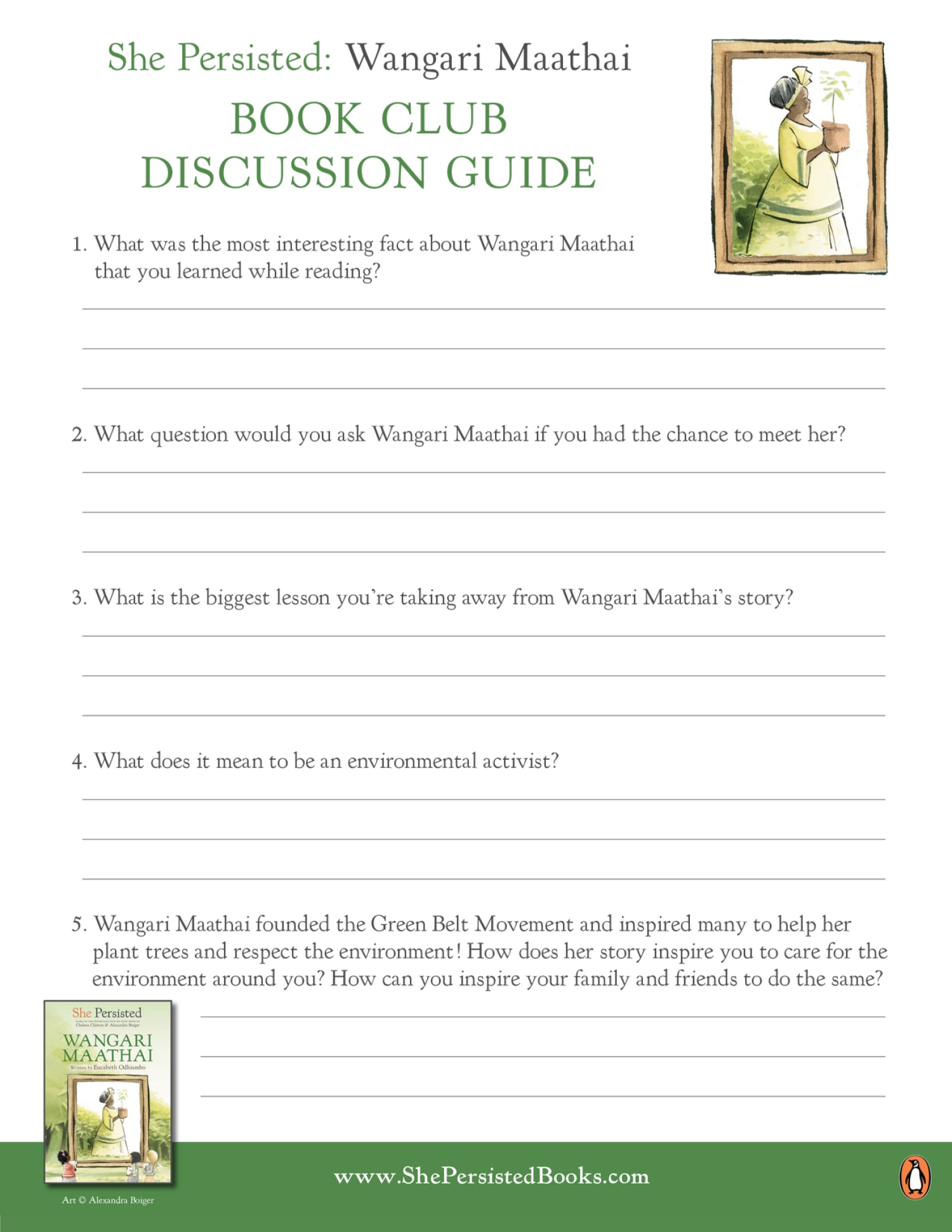
She Persisted: Wangari Maathai - Downloadable Resources
Q&A with Eucabeth Odhiambo
What was the most interesting fact about Wangari Maathai that you learned in your research?
The most important fact I discovered in my research about Wangari Maathai is that when she was 3 years old, her family joined their father in Nakuru, where he worked for a white man. They were treated harshly, like enslaved people were still. There were no schools for her to attend, instead she helped take care of the cattle and helped her mother. Being out in the fields a lot changed her life. She learned to love nature. She understood what it meant to have a healthy environment. This understanding lead to her fight for a healing of the environment as an adult.
What is the biggest lesson you hope young readers take away from the book?
Wangari started fighting to preserve and understand the environment when nobody was doing it in Kenya. She taught us that we do not need to wait for someone to start before we get involved. She believed in what she was doing and took the lead. Even when her life was in danger, she continued to organize people and support the planting of trees. She also asked for help when she needed it. This teaches us not to give up, even if we are alone. Always ask for help from people who you know are interested in what you are doing. I hope her story encourages these young readers to speak out when they see injustices against helpless people; to use everything within their power to push back against injustice and corruption; and to support what is right.
How did you do the research for this biography?
There are many wonderful books about Wangari Maathai. However a few sources brought my story to life. The first is a memoir titled Unbowed, written by Wangari. I listened to and read Wangari’s Nobel lecture, when she accepted the Nobel Peace Prize in 2004. I listened to and read On Being, an interview by Krista Tippett. In these sources, I was able to read and listen to Wangari’s own voice and thoughts. I drew from memories of Wangari’s activities and my involvement in tree planting, which gave me a clear understanding of her life’s work as I wrote the biography. I also interviewed my husband, who was her student at Nairobi University. I wanted to hear what he had to say about Wangari as a teacher and public figure.
What question would you ask Wangari Maathai if you had the chance to meet her?
I have so many questions to ask her, but these are a few I would ask. I would ask her if she was ever scared when she was in prison. I would also ask her why she did not stop in order to protect her children. I would ask her if she was willing to die for her values, knowing that the government at that time was ready to get rid of her if they could.
What does the Persisterhood mean to you?
To me, Persisterhood means that anyone who is persisting and has been persistent in anything they do or any woman who wants to make a difference belongs to this sisterhood. Our privilege as writers is to share the persistent spirit of the sisters from all walks of life. We belong together and this bond connects generations and nationalities of women who persist. Like Wangari, continue to persist and you belong to the Persisterhood.